
You walk out one morning, look down at your driveway, and there it is. A crack. Maybe a few of them. And your first thought is probably — how did that happen and how bad is this?
We hear this all the time. Cracking is honestly the number one thing people call us about at WestShore Paving. And after 20 years of fixing asphalt across the Tampa Bay area, we can tell you — it’s almost always fixable. But you need to understand what caused it first, because the cause determines the solution.
So let’s get into it.
Not All Cracks Are Created Equal
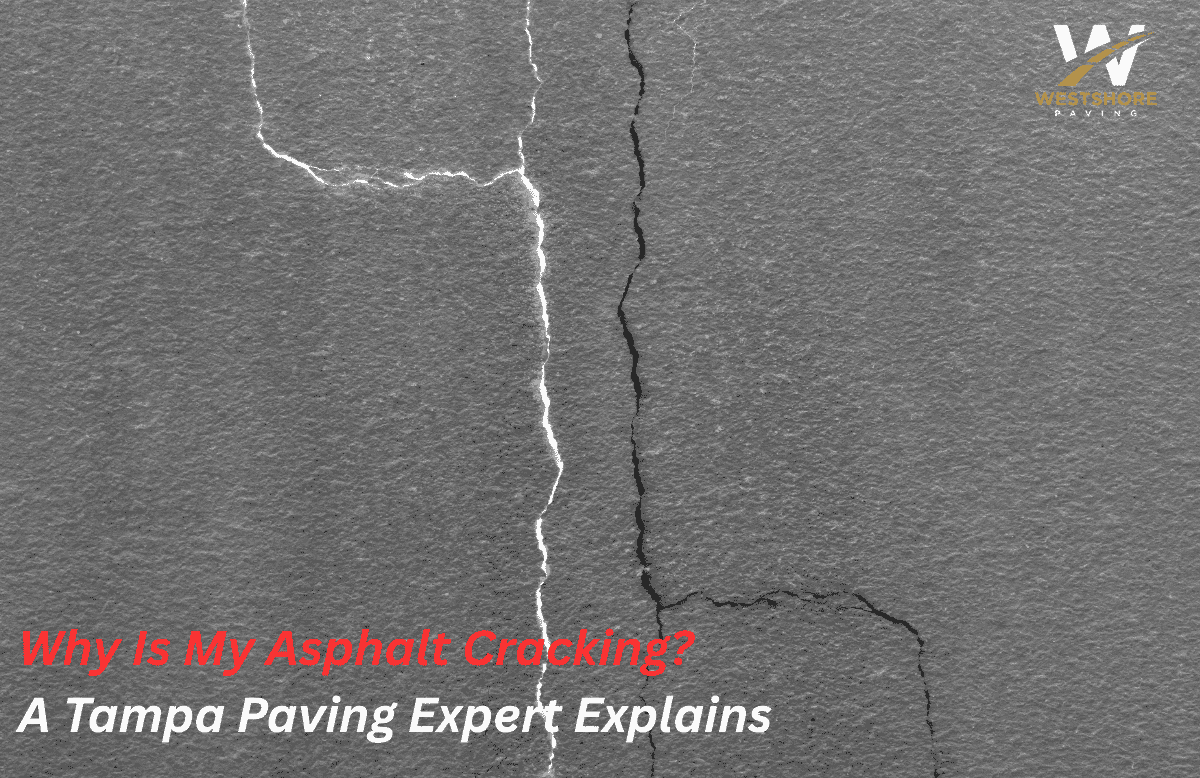
Before anything else — take a breath. A crack in your asphalt doesn’t automatically mean disaster. Some cracking is completely normal on an older surface. What matters is what kind of crack you’re looking at and how fast it’s spreading.
A few small surface cracks on a driveway that’s been around for 12 or 15 years? Pretty normal. Deep cracks spreading fast on something that’s only 4 years old? That’s a different conversation. Once you know what you’re dealing with, the path forward gets a lot clearer.
So Why Is Your Asphalt Actually Cracking?
The Florida Sun Is Doing More Damage Than You Think
This is the big one nobody talks about enough. Tampa gets brutal sun basically year round. And that constant UV exposure slowly breaks down the oils inside the asphalt — the stuff that keeps it flexible and holds everything together.
Once those oils break down, the surface dries out and gets brittle. And brittle asphalt cracks. You’ll notice it starts looking faded and grey instead of that deep black color it had when it was fresh. That grey color is your driveway waving a flag at you.
The fix for this is sealcoating — and in Florida we really do recommend doing it every 2 to 3 years, not every 5 like some people suggest. Our sun is not the same as Minnesota sun. Staying on top of sealcoating stops this type of cracking before it starts.
Water Is Getting In Somewhere
Florida rain is relentless. And water is incredibly patient — it will find any gap, any tiny crack, and work its way down into the base underneath your asphalt. Once it’s in there it weakens the foundation. And when the foundation weakens, the surface above it starts to crack and shift.
This is exactly why small cracks need to be dealt with straight away. Not next month. Not when you get around to it. A tiny crack that costs almost nothing to fill can turn into a base repair that costs significantly more if water gets in and does its thing over a wet Florida summer.
We do crack filling and sealing for driveways and parking lots all the time — and honestly the customers who call us early always come out ahead financially compared to the ones who waited.
Your Trees Might Be the Problem
This one genuinely surprises people. Florida trees grow fast and their roots spread wide. Those roots don’t know or care that there’s asphalt above them — they just keep growing. And eventually they push up against the surface hard enough to crack it.
If you’ve got cracks that seem to follow a specific path, or sections of your driveway that are raised or uneven, have a look at what’s growing nearby. Root damage needs the surface and the root situation addressed at the same time — otherwise you fix the crack and the root just breaks it open again.
Heavy Vehicles Are Stressing the Surface
Residential driveways are designed for regular cars. Parking a heavy truck, an RV, or a commercial vehicle in the same spot repeatedly puts the kind of load on the surface it simply wasn’t built for. Over time you start seeing what’s called alligator cracking — a pattern of interconnected cracks that looks almost like scales. It’s named that for a reason.
Once alligator cracking shows up it means the base underneath is struggling, not just the surface. Sealcoating won’t touch this one. You need proper patching that goes deeper and addresses what’s happening below the surface.
It Might Just Be Old
Sometimes the honest answer is that the asphalt has had a good run and it’s time. A surface that’s 20 to 25 years old and cracking heavily in multiple spots isn’t really a repair job anymore — it’s a replacement conversation. Continuing to patch an aging surface past its useful life is like putting a bandage on something that needs surgery.
If that’s where you are, removal and replacement is actually more cost effective in the long run than repeated repairs on a surface that’s done.
A Quick Way to Read Your Cracks
Here’s a simple guide to what you’re probably looking at:
Thin surface cracks across a wide area — UV damage and oxidation. Sealcoat and fill cracks soon.
One or two larger cracks — water getting in. Fill them now before the base gets involved.
Alligator pattern cracks — base or load issue. Needs patching not just filling.
Cracks along the edges — edge support failing or drainage issue pulling the border apart.
Raised or uneven cracking — tree roots underneath pushing up.
When Is It Time to Call Someone?
If the cracks are small and your surface is generally in decent shape, staying on top of sealcoating and filling cracks as they appear is usually enough. But if you’re seeing cracks that keep coming back after being filled, sections that are sinking, alligator patterns spreading across large areas, or cracking that appeared fast on a relatively young surface — get someone out to look at it properly.
Those are signs something deeper is going on and a tube of crack filler from the hardware store isn’t going to solve it.
Here’s the Thing About Cracks
They don’t fix themselves. And they don’t stay the same size. Every rain, every hot day, every car that drives over them — they get a little worse. The people who call us early almost always spend less and end up with a better result than the ones who kept an eye on it for two years before doing anything.
If you’ve got cracking you’re not sure about, just give us a call. We’ll come out, take an honest look, and tell you exactly what’s going on and what it actually needs. No unnecessary work, no pressure.
📞 Call us at 352-587-4016 🌐 Get a free assessment here
Services that can help: